Should You Remove Original Insoles Before Adding New Ones?
Written and reviewed for clarity by the AUREZA TOUCH Editorial Team.
Should you usually remove the factory insole?
For a full-length replacement insole, the safest starting point is usually to remove the shoe’s original removable liner. The American Academy of Orthopaedic Surgeons explains that shoes with removable insoles offer more flexibility because the liner can be replaced without using extra interior space. That matters because a second full layer raises the foot inside the shoe.
Oxford University Hospitals gives similar practical advice for orthoses: taking out the original inlay creates more room. The principle also applies to everyday comfort insoles. You are not removing the liner because two layers are automatically harmful; you are making sure the shoe still has enough depth for your toes and heel.
A thin heel pad or a small three-quarter insert is a different case. Those products may be designed to sit over a liner. Check the product instructions rather than assuming every insert should replace the same part of the shoe.
How can you tell whether the original liner is removable?
Take the shoe off, loosen the laces fully and lift the liner at the heel. A removable liner normally comes away with gentle, even pressure. You may need to ease it forward a little before lifting the toe.
Do not pull hard if the liner is strongly glued, stitched into the shoe or begins to tear. Dorset County Hospital’s trimming guidance says an existing insole can often be removed gently, but advises against removing one held by thick, strong glue. A damaged base can create lumps or rough edges that are worse than the space you hoped to gain.
If the liner will not come out, compare the new insole’s thickness with the available shoe depth. A thinner replacement, a roomier shoe or a different insert format may be the better answer.
What is the quickest fit test after inserting the new pair?
Fit one shoe first and keep the other unchanged for comparison. Wear the same socks you normally use. Stand, walk, climb a few steps and pay attention to four areas: toe room, heel hold, side pressure and stability.
Your toes should be able to move without brushing the upper. Your heel should sit securely rather than lifting out of the heel cup. The sides of the shoe should not squeeze, and the insole should lie flat without curling. The American Podiatric Medical Association stresses that an insert must fit the shoes in which it will actually be worn; a good insole in the wrong shoe is still a poor setup.
If the new insole is trim-to-fit, use the removed factory liner as a template. Trim a little at a time. Cutting too much cannot be reversed and can allow the insole to slide.
When can stacking two insoles be acceptable?
Layering can sometimes work when the factory liner is very thin, fixed in place and the shoe has generous depth. It may also be appropriate when the added product is explicitly designed as a partial pad rather than a full replacement.
The decision is about fit, not a universal rule. If stacking raises the heel above the shoe’s counter, reduces toe space or changes how the foot lands, remove a layer or choose another shoe. Do not try to solve tightness by compressing the foot into the shoe.
Test indoors on a clean surface before committing to a full day. A few minutes of walking often reveals heel slip, pressure across the top of the foot or an insole that bunches at the toe.
Which warning signs mean you should stop?
Remove the new setup if it causes persistent pressure, rubbing, numbness, new pain or a feeling that the foot is unstable. Check that the insole is the correct way round, fully flat and correctly trimmed. Then try it in a roomier, supportive shoe.
Sudden or severe pain, ongoing numbness, marked swelling or an injury needs qualified assessment rather than another layer of cushioning. A comfort insole can change how a shoe feels, but it does not diagnose or treat a medical condition.
Where does AUREZA TOUCH fit?
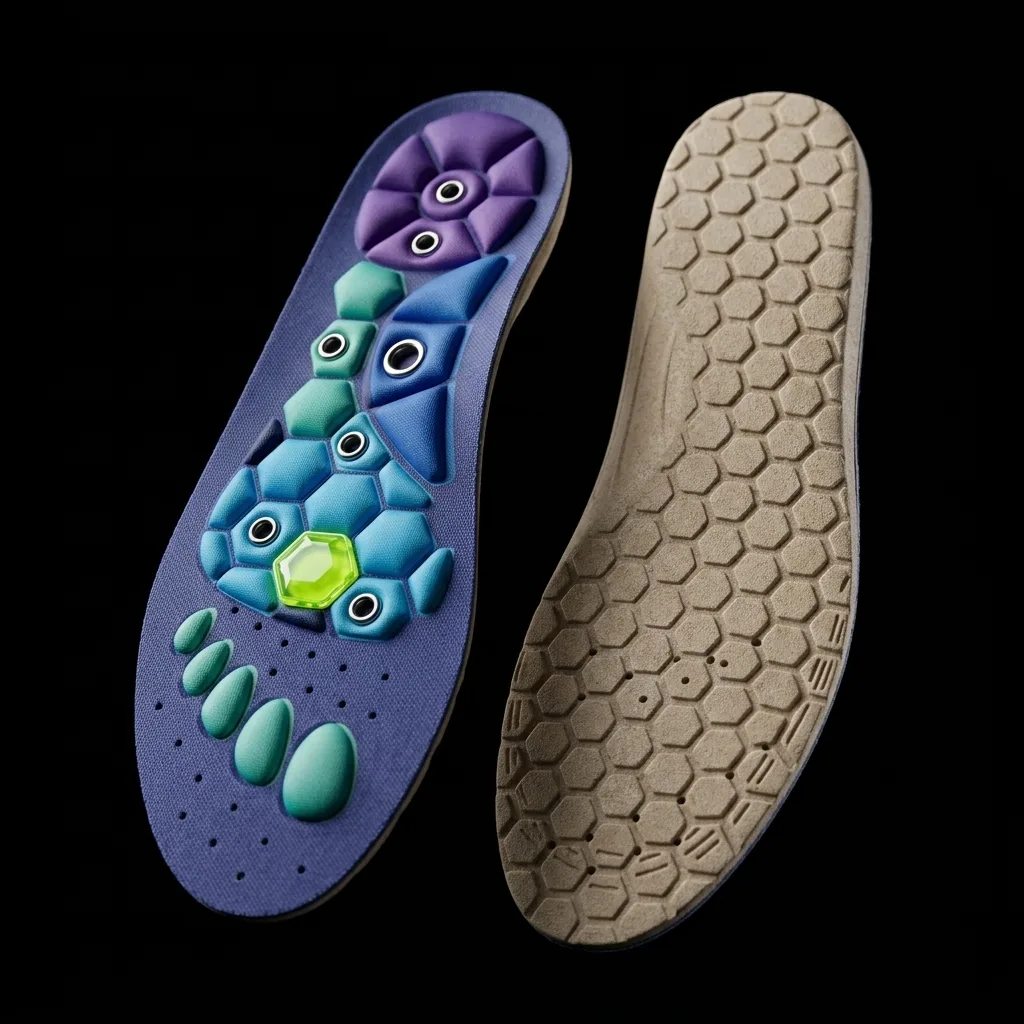
AUREZA TOUCH is a trim-to-fit everyday comfort insole, not a medical device. For most full-length installations, start by removing a removable factory liner, copy its outline carefully and test the new fit indoors. The right result should feel secure and spacious enough—not simply softer.
Sources checked
General information only — not medical advice. AUREZA TOUCH is a comfort product, not a medical device. Seek qualified care for persistent, severe or sudden pain, numbness, swelling or injury.
Published: